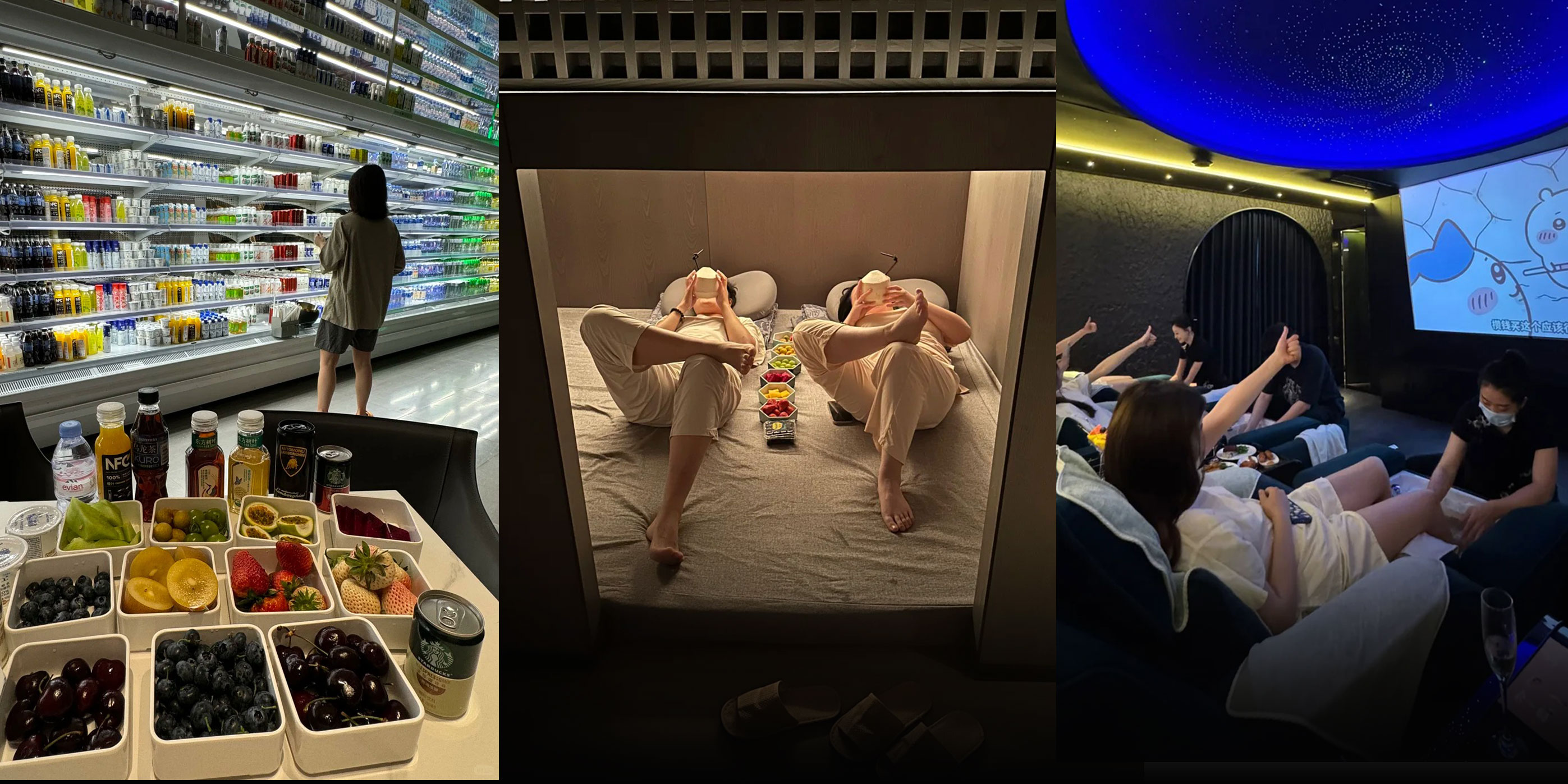
Why Young Chinese Are Flocking to Bathhouses
During the recent May Day holiday, Xue Jiayu traveled to Shanghai with a friend. But her goal wasn’t to see the Bund — the city’s famous waterfront — the Shanghai Museum, or even sampling the city’s cuisine.
She was going to a bathhouse.
Over the past year, the 27-year-old from the eastern Jiangxi province has made a habit of seeking out local bathhouses on every trip she’s gone on within China. Beyond the low cost and easy access, she says what truly draws her to the venues is their “emotional value” — a sense of belonging, recognition, and care derived from the services they provide.
“For me, traveling is mainly about relaxing,” Xue says. “Right now, I just like lying on beanbags. (At a bathhouse) I don’t need to put on makeup, and I can eat whenever I’m hungry.”
China’s bathhouses today offer far more than bathing — they double as budget-friendly accommodations and leisure destinations, featuring hot springs, saunas, video games, KTV, and more. Many venues offer unlimited drinks and food such as freshly cut seasonal fruits, barbecue, dim sum, and desserts. Guests often spend entire days at the venues, even staying overnight for a small added expense.
“In Shanghai, a mid-to-upper-range hotel in a good location used to cost me at least 500 yuan ($74) a night,” Xue says. “But at a bathhouse, I only need to spend 150 yuan on a ticket, and the overnight fee is just 50 yuan.”
The industry is booming: according to a report released last year by Meituan, China’s leading service app, the bathhouse market had until 2025 grown for four straight years, and spa ticket purchases in that year experienced a more than 20% increase compared with 2024, pushing the market past 110 billion yuan. Searches for bathhouse “girls’ gatherings” and “company team building” on Meituan also rose 230% during the same time frame. And young Chinese are driving the trend, with Gen Z now accounting for 28% of bathhouse customers.
High-end bathhouses — spas offering luxury décor, multiple bath choices, and specially trained personnel that cost upwards of 1,000 yuan per stay — are also gaining traction. Yuan Baochen, a 25-year-old graduate student, visited Shanghai’s Qushui Lanting luxury spa chain after hearing the buzz about its “top-tier experience.” Her first visit last October cost 799 yuan for entry and 500 yuan for a body scrub, plus a 10% service charge — totaling around 1,600 yuan.
“The value for money is relatively low, but the overall experience is truly high-end,” she says. “The bath products, as well as the food and drink quality, are excellent.”
She also praised the personal attendant — a worker who scrubs customers — at Qushui Lanting, noting that the 10% service charge was well worth it. “The attendant … proactively offers milk tea and fruit, chats with you, and keeps the conversation going.”
Yuan grew up experiencing bathhouse culture with her family in the central Henan province. As an adult, she has tried at least three bathhouses in each city where she has lived, including Shanghai and cities in the southern provinces of Hainan and Guangdong.
“For me, bathing is not only a habit I’ve had since I was a child, but also a way to relax both body and mind, and explore local culture,” she says.
One of her regular spots offers a more affordable experience. A 53-yuan entry fee includes unlimited standard drinks, while adding a buffet meal and a body scrub comes to around 150 yuan total. Guests can make use of the facility’s computers and enjoy billiards and virtual golf.
For 22-year-old Zou Yixuan, a college student in Shanghai, bathhouses are a familiar comfort. In December, Zou visited a branch of Shanghai’s Shuiguo Tangquan bathhouse for a university team-building event — a choice of outing that has become increasingly popular in the last two years. Because the venue is surrounded by universities, its clientele consists largely of college students — often in groups. “Some even pay a premium to stay overnight and work on their theses, and the store thoughtfully offers free printing services,” she says.
The popularity of bathhouses also extends to the corporate world. Last year, many companies forewent holding their year-end parties in hotels and hosted them at bathhouses instead, says Zhao Xuewang, president of the Xiangshanghui Hotel Group, which operates both the Qushui Lanting and Shuiguo Tangquan spa chains.
Zhao says that whether a bathhouse sinks or swims depends on customer understanding. “True competitiveness comes from anticipating needs and sometimes exceeding them,” he says.
He also believes that people today have high “internal dampness,” a concept in traditional Chinese medicine (TCM) thought to cause bloating and fatigue. He says he hopes that at bathhouses, “they can relax, sweat it out, and dispel that dampness.”
Since opening its first location in Shanghai in 2025, Shuixie Lanting, another high-end bathhouse costing between 1,200 and 1,500 yuan per person, has quickly become a sanctuary for young professionals seeking respite from the urban grind. The bathhouse plans to open a second Shanghai location before the National Day holiday in October and is eyeing expansion into the neighboring Jiangsu and Zhejiang provinces in the coming years.
The bathhouse’s target demographic is urbanites aged 20 to 45, with a focus on the 25 to 35 age group. “People in this age range have their own consumption preferences, and a stable source of income,” Xiang Guangyu, CEO of Shuixie Lanting, says.
The facilities themselves function as a 24-hour ecosystem. Beyond hot baths, the space features TCM treatments, PS5 gaming zones, tea lounges, a small bar, an infinity pool, chess rooms, and overnight accommodations.
Xiang says that many people come alone. “They’re looking for a spiritual refuge to relax and destress. In a fast-paced city like Shanghai, many young people need to go to a quiet, private space to escape reality.”
And because many venues are open 24 hours a day, they appeal to guests of all professions and schedules. Early risers — often those who prefer fewer people — arrive at 8 or 9 a.m. Later, tech workers with irregular schedules drift in after all-nighters to eat, relax, and sleep.
Xiang believes the “one-stop experience” is the primary draw. “Everything from dining and accommodation, to video games and board games is available. To some extent, it replaces traditional hostels and hotels.”
Ultimately, he says the appeal boils down to emotional value. “Young people today don’t care if you are a star-rated hotel or a big chain,” he says. “What they care about is how much emotional value you can provide and how you make them feel.”
Services like steam baths, massages, and aromatherapy cater to a generation that increasingly places importance on mental and physical health. Unlike older generations who focus on diet and walking, Xiang says today’s youth seek active wellness, relieving fatigue and improving sleep.
“You shed your outer clothes, and you shed that invisible shell,” says Xiang. “You put on the same uniform as everyone else. In this space, there are no social classes — everyone is relatively equal. That’s how you find physical and mental well-being.”
Zhao, the hotel group president, is highly optimistic about the industry’s future. “I believe it will only get better. It represents a new type of consumption, a new way of life ... No one would say no to a better life.”
Editor: Marianne Gunnarsson.
(Header image: Photos of bathhouse experiences shared by Xiaohongshu users)